[Main Page] | [History] | [Vaudeville] | [Misc.] | [Films & Film Projects]
| Mikael Uhlin's Marxology @ marx-brothers.org
[Main Page] | [History] | [Vaudeville] | [Misc.] | [Films & Film Projects] |


|
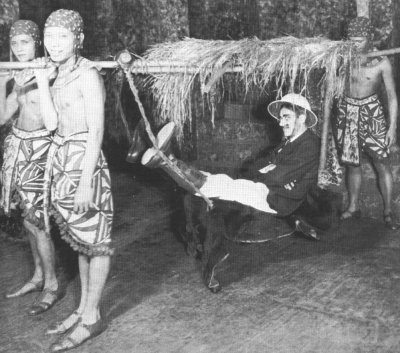
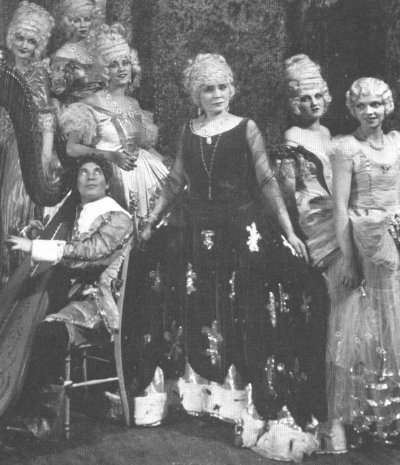
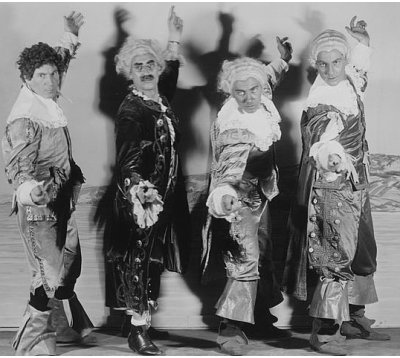
Animal Crackers, the Marxes' third Broadway musical and second movie, has music and lyrics by Bert Kalmar and Harry Ruby and a book by George S. Kaufman and Morrie Ryskind. Alexander Woollcott mentioned the stage follow-up to The Cocoanuts in his column in December 1927 and described it as "a farce dealing with Long Island life and called While London Sleeps." It opened on Broadway on 23 October 1928 at the 44th Street Theatre, and ran for 191 performances and then toured. The film premiered on 23 August 1930. The Court of Louis the 57thA revamp of Napoleon's First Waterloo from I'll Say She Is! occupied the third scene of act two in the play but was almost entirely removed from the film save for the wrap-up of the plot. It was probably director Victor Heerman who suggested this for the sake of brevity. This also removed what was originally Harpo's musical spot which - as in the film version of The Cocoanuts - was inserted elsewhere. At the time of the filming of Animal Crackers it was said that the scene would be filmed on another occasion but it never was. Often referred to as "The
Du Barry-scene", The Court of Louis the 57th
has been described as a "play in the play", where the guests of Mrs
Rittenhouse portrayed figures from the court of Louis 57th in a costume
party. Introduced by The Royal Filipino Band, the
guest of
honour, Captain Spaulding, was the King while Mrs Rittenhouse was his
Queen. This didn't prevent him from arranging a liasion with Du
Barry,
alias Mrs Whitehead. Like Napoleon's Josephine, Du Barry had to wrestle
on a sofa, being upended and thrown by all four Marx Brothers, fully
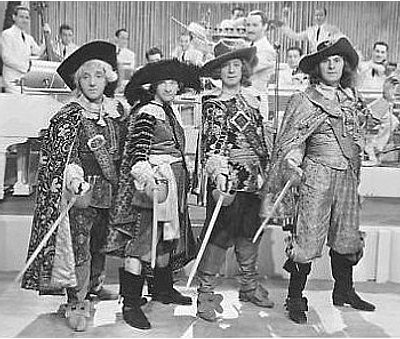
dressed in French court regalia. The scene ended with Kalmar-Ruby's
song Musketeers,
which featured all the Four Marx Brothers. Groucho (wants to make
certain that Monsieur Du Barry is out of town) Du Barry Sire, I fear for me to come here is indiscreet. Groucho Nonsense, you'll be in the street sooner or later. You come from good stock, you'll probably be on the curb. Ah, Du Barry, you look wonderful in that French dressing...May I call you Du, Du? Du Barry As you will, milord. Groucho (calls for champagne) What do you think, do you think we'll ever get the saloon back?...And if we do, what's going to become of the bellboys in the Hotel Astor? Hives, the butler Doucet, the French Premier. Doucet Compliments, Your Majesty. Herzegovina has declared war upon us. Groucho If you think I'm going to let my army fight with a Pullman car, you're crazy. MusketeersHooray for Captain SpauldingThe Power CutHungerdunger, Hungerdunger, Hungerdunger, and McCormickGroucho Dear Elsie, no never mind
Elsie.
Zeppo Do you want me to scratch
Elsie?
Groucho Well, if you
enjoy that sort of thing, it's quite alright with me. However, I'm not
interested in your private affairs, Jamison. Begin this way... let's
start all over again...
It's easy to tell this has been cut since
Groucho
does a screen jump similar to the one in the Hooray for
Captain Spaulding-number. The second edit is after the
following dialogue;
Groucho I tell you what you do, Jamison, I tell you what, make it three windshield wipers and one Hungerdunger. They won't all be there when the letter arrives anyhow. Zeppo Hungerdunger, Hungerdunger, Hungerdunger, and McCormick. Groucho And McCormick. Then the following is cut. The edit is harder to see since there is a change in camera shot. Zeppo Dear Elsie, scratch. Groucho That won't do, Jamison. That won't go thru the mail the way you've got the letter. The way you've got it, McCormick is scratching Elsie. You had better turn that around and have Elsie scratch McCormick. You'd better turn McCormick around too, Jamison and see what you can do for me. 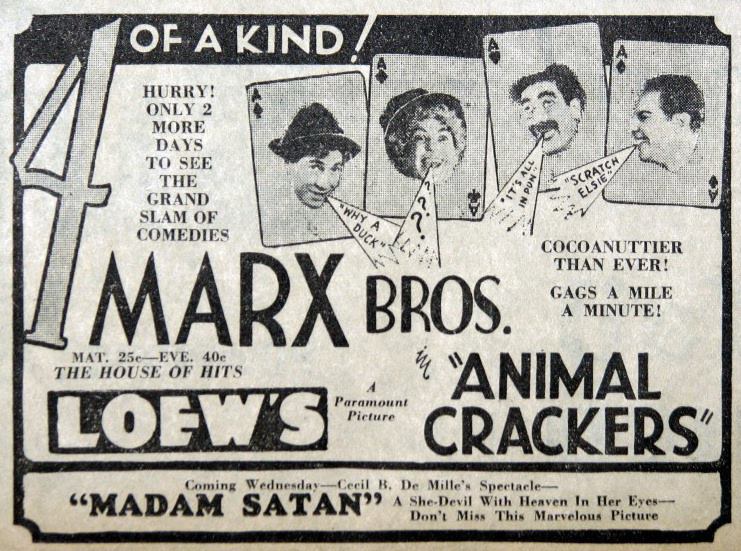 RevivalsThe Marxes revived the "The Du Barry-scene" for personal stage appearances in New York in August 1931, and in 1956 Chico talked about the possibility for the Marxes to produce a colour re-make for TV (which they never did, of course). Animal Crackers have been revived on stage by others on several occasions over the years. In August 2002, the Oxford University Dramatic Society performed the play in Edinburgh, Scotland under the direction of Sam Leifer. At 60 minutes, the show was described as a great reconstruction of the madness of the Marxes. Leifer's production was totally in black & white with a vaudevillian touch. Hooray for Captain Spaulding announced the classic entrance on Sudan chair by Captain Spaulding, played by James Wilton. He got well into his stride with "Hello I must be going" before going into the opening dialogue with Mrs Rittenhouse (played by Jessie Burton). The original dialogue mixed pieces of the opening of Duck Soup (like the business with the vaccination with the phonograph needle). Ravelli (played by rock band drummer Johnny Lewsley) and The Professor (played by Andy King) joined in the nonsense and basically followed the plot through to the sleepy conclusion. There were some greatest hits thrown in, like the exchange of contracts between Groucho and Chico and Everyone says I love you. Also, the famous painting (the "Pictch") on exhibition in Mrs Rittenhouse villa was substituted for a statue (or "Statch"). The show was recreated twice during the summer of 2003. First by the Actors Net of Bucks County in Morrisville, Pennsylvania, then by The Riverwalk Theater in Lansing, Michigan. Again, the famous painting was changed into a new sculpture but they re-introduced a character from the original show that was omitted in the Marxes' film version, i.e. the young gossip columnist who becomes the love interest of Arabella Rittenhouse. In this show, Spaulding was played by Curt Lippe, Ravelli by Susan Ferrara Barto, The Professor by Joe Doyle and Jamison by Chuck Donnelly. This version of the show included the DuBarry scene and The Musketeers. In an e-mail, Lippe wrote: "Something funny that happened on opening night in that scene. Spaulding keeps getting interrupted trying to make time with DuBarry on the couch. While I'm sitting on her lap, Harpo is supposed to come in chasing a girl and switch the empty wine bottle he stole earlier in the scene with a full one. As he leaves with the girl Spaulding says "Say, just a minute, you've got a nickel coming to you for the empty bottle". Well, the girl missed her cue and wasn't ready, and Harpo didn't make his entrance. So I was sitting on DuBarry's lap, looking over my shoulder, and no Harpo. Bewildered, I started saying things to her like "Do you think you could grow a little more lap" and "Hey, feel like singing one of those songs we sang earlier tonight?". The audience started picking up that it was a mess-up and started howling, and things just got crazier. Finally Harpo came on alone and we continued - but that might have been the closest real "Marx moment" we had - knowing what we do of their improvisational skills! " |
Musketeers(Bert Kalmar - Harry Ruby) Unless we tell you who we are, you'll never
guess
chorus
patter
second chorus
Musketeers (as performed by the Yacht Club Boys in the film Cocoanut Grove)(Bert Kalmar - Harry Ruby - Charles Adler - George Kelly - James Kern - Billy Mann)
We're four of the three musketeers
As we bring a local marching song the
population cheer En garde! Á vous! So we like to win lots of goo |