[Main Page] | [History] | [Vaudeville] | [Misc.] | [Films & Film Projects]
| Mikael Uhlin's Marxology @ marx-brothers.org
[Main Page] | [History] | [Vaudeville] | [Misc.] | [Films & Film Projects] |
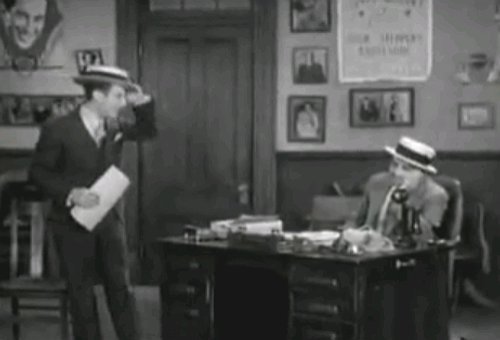
Zeppo opened the successions of imitations at the Theatrical Agency, the opening scene of both On The Balcony and I'll Say She Is, with the line "My name is Sammy Brown and I just came into town" but who was Sammy Brown? In The Marx Brothers Scrapbook, Groucho said that "we'd all come out and introduce ourselves with a song that began 'My name is Sammy Brown, I just came into town...' and somehow we'd end up with the Darktown Strutters Ball." My original assumption that "Sammy Brown" was either an artist or a character in some song by any of the artists that were imitated in various versions of the skit (Gallagher & Shean, Joe Frisco, and - in Britain - Charlie Chaplin) can't be verified. There was a blues/gospel singer and pianoplayer named Sammy Brown who recorded in the 1920's, but I haven't found any connection with the guy the Marxes were imitating. There is, however, a connection between Joe Frisco and a musician named Tom Brown.
Like most early white New Orleans Jazz musicians, trombonist Tom "Red" Brown was a veteran of Papa Jack Laine's Reliance. Brown claimed to be the first to use the word "Jass" to describe the music that was coming out of New Orleans. In 1913, Joe Frisco and his dancing partner Loretta McDermott were performing in New Orleans when Tom Brown assembled a group of local musicians as a back up band. Brown's Dixieland Jass Band consisted of Tom Brown on trombone, his brother Steve on bass, Ray Lopez on cornet, William Lambert on drums, Arnold Loyacano on guitar and Larry Shields on clarinet. Frisco was so impressed with the "Jass" music he heard that kept talking about it when he returned to Chicago. In 1915 Frisco asked Brown to assemble a group and bring them north for an engagement in Chicago. The band then travelled to New York and had a successful run in 1916 but then broke up. Brown returned briefly to New Orleans but booking agents in New York were still contacting him wanting a "Jass" band. He recommended another White New Orleans Jazz band, Stein's Dixieland Jass Band that was playing in Chicago at the time. Johnny Stein was under contractual obligation in Chicago and couldn't make it, but the rest of the band accepted and moved to New York where they became the Original Dixieland Jass Band (an obvious attempt to associate themselves with Brown's Band From Dixieland) and went on to record the first Jazz record in 1917.
Around
this time there was another Tom Brown touring with his orchestra, The
Six Brown Brothers, which is another possible source for the Marxes' "Sammy
Brown".
They wery popular in vaudeville, on Broadway and on records in the
1910s and 1920s and the Six (sometimes Five) Brown Brothers show
several similarities with The Marx Brothers. In both cases there were
originally six brothers, albeit not in the group at the same time, and
in both cases one of the brothers died in a flu epidemic (Manfred Marx
in infancy in 1886, Percy Brown 36 years old in 1918). The Six Brown
Brothers became famous combining comedy with virtuoso saxophone
performances, a sheer novelty at the time when the saxophone was first
becoming popular. Their trademark costuming was five clowns and a
blackface. Leader of the group (and always appearing in blackface) was
Tom Brown (1881-1950) and although not all of them were in the group
simultanously, his brothers William (1879-1945), Percy (1882-1918),
Alec (1884- ?), Vern (1889-1964) and Fred (1890-1949) participated at
one time or another. The group kept changing members over the years and
there were several "false" Brown brothers. One Harry Fink was in the
group for several years (as Harry Brown) and there might even have been
a "Samuel Brown", as a Samuel Goldberg described himself as a former
member in a letter to a publishing company in 1920. There were also
several copycat acts. Some of them were authorized, but the
unauthorized Brown's Saxophone Six (a. k. a. C.L.
Brown's Saxophone Sextette),
led by the unrelated C.L. Brown and previous ringer Billy Markwith,
caused a lot of trouble as they copied both the advertising and stage
appearances of the real Six Brown Brothers (with Markwith in
blackface). This problem with imitators is something the Marx Brothers
might have used as a joke, as all variations of the Theatrical Agency-skit
were based on prospering artists imitating famous acts. One objection
might be why the Marx Brothers didn't play saxophones in the imitation
but there is another delicate connection; Guy Shrigley, one of the fake
Browns, composed a 16-bar strain to the Brown Brothers's recording of
Joe Frisco's theme song Darktown
Strutter's Ball.
Here's some other interesting (but probably unintentional) connections
between the Marx and the Brown Brothers:
There may also be an echo of the saxophone-playing Brown Brothers in Monkey Business in the scene where the Marx Brothers interrupt their flight on the ship, and grab some saxophones to play a short but very lively tune. This has been identified as an uptempo version of Sweet Adeline, the barbershop tune the Marxes are singing in the first scene of the film, and sure enough, The Six Brown Brothers performed that song too and even made a recording of it.
Read more about the Six Brown Brothers in this article by Bruce Vermazen.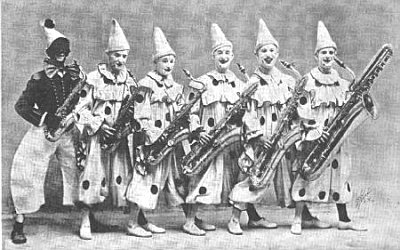 .
.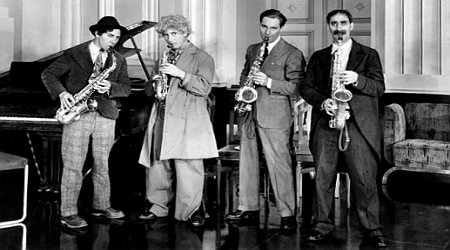
The Six Brown Brothers vs the Four Marx Brothers
"Everybody was named Brown or Williams",
George
Burns said about vaudeville when interviewed in 1978 by Arthur Cooper
for Playboy Magazine. Burns tells about Brown and Williams,
"singers, dancers and roller skaters", and how he
became "Williams" when the original guy split up
with Brown;
"And we did the same act. Well, everybody did that act and we
didn't
even have enough sense to change our names. Everybody was named Brown
or Williams. There was Brown and Williams and Williams and Brown and
there was Brown and Brown and there was Williams and Williams and there
were the Brown Brothers and the Williams Boys".
In Charlotte Chandler's book Hello, I Must Be Going,
Burns further adds that his partner actually called himself Sam Brown!
This may the same fellow that he knew as a kid, Abie Kaplan, "who"
(Burns says in the Playboy-interview) "was later Brown of
Brown and Brown". So, there actually was a Sam Brown in
vaudeville who knew both the Marx Brothers and George Burns.
In a German propaganda cartoon from World War II, an allied soldier is called "Sam Brown". In an e-mail sent in May 2010, signature Oilyfool writes:
The "Sam Brown" reference in the German WWII cartoon refers to the Sam Browne belt issued as standard officers' kit in the British army. It is eponymously named after the actual Sam Browne, a British officer who served in India in the 1890s. He suffered in battle an amputative sword cut to his left arm, which left him unable to draw his sword. He designed the belt to provide stability, allowing him to draw his sword one-handed. It became official officers' gear in both the British and US Armies around 1900 (see Wikipedia for further details). When the sword was replaced by the pistol as a standard officers sidearm (except ceremonially), the belt was retained; you can see Peter O'Toole wearing one in the film Lawrence of Arabia, and in photos of the real T.E. Lawrence from during WWI. How does this link to Zeppo? As you know from your research, Zeppo replaced Gummo in the Marx Brothers stage act in 1918, when Gummo joined the US Army prior to the end of WWI. It is my considered guess that Zeppo's "I'm Sammy Brown, and I'm back in town" was a catch phrase popular immediately after WWI, when the soldiers, including his brother Gummo, returned home.
An interesting theory and Oilyfool may have found the solution.
Additionally, back in 1866 there was a Sam Brown, chief scout for Fort Wadsworth (now known as Fort Sisseton) in South Dakota. Having been told of an approaching Sioux Indian war party, Sam sent a warning message to a fort further north. When he discovered that the war party was simply several Indians delivering word of a new peace treaty, he decided to intercept the warning in order to prevent bloodshed. He managed to reach the northern fort by morning but as he slipped from his horse, exhausted and half frozen, he was unable to stand. Sam Brown's heroic 150-mile ride cost him the use of his legs and he never walked again.
Thanks to Anne
Botterbusch for the original Sammy Brown-discussion.