[Main Page] | [History] | [Vaudeville] | [Misc.] | [Films & Film Projects]
| Mikael Uhlin's Marxology @ marx-brothers.org
[Main Page] | [History] | [Vaudeville] | [Misc.] | [Films & Film Projects] |
When the Marx Brothers had released The
Big Store in 1941 - at the time annonuced as their
last film - Chico fulfilled an old wish to form a big band
of his own.
Having linked up with jazz band manager Ben Pollack, he
launched his solo career in January 1942. Pollack was the head but
Chico had name recognition and fronted the band at the piano. They
assembled a group of sixteen solid musicians including eight brass
(three trombones), six saxophones plus a vocal group.
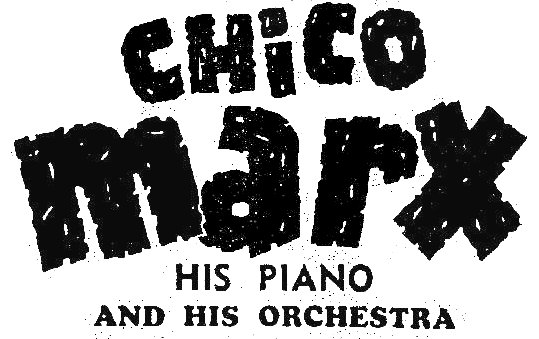
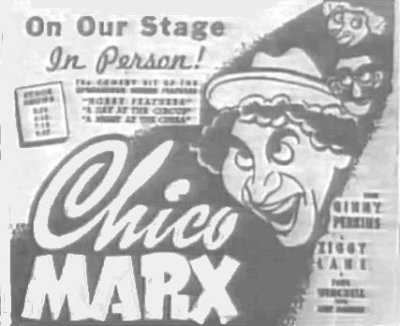
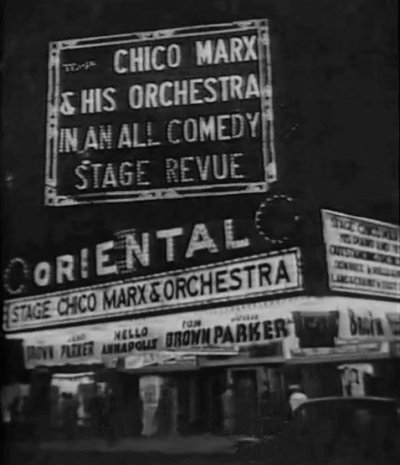
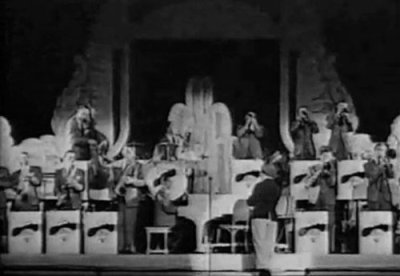
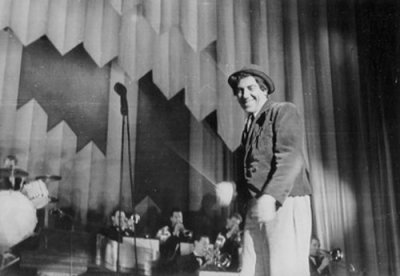
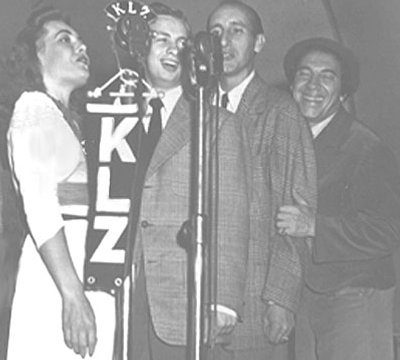
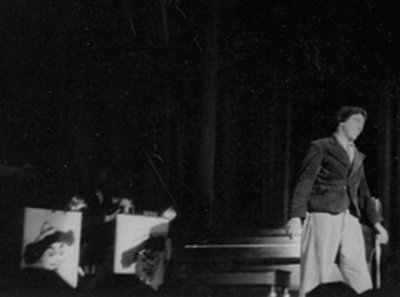
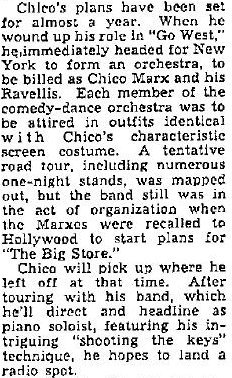 Salt Lake Tribune, 8 July 1941 (provided by Nancy Mess) Chico's band did fairly straightforward dance-band material, enlivened by his distinctive fingerwork on the keys. Chico performed 15 minutes of his inimitable piano solo but the show usually started with a couple of tunes from the orchestra. After the first numbers Chico would come out for a short monologue and then introduced the vocalists. While they were singing in group or solo, Chico would sit on the edge of the bandstand eating a banana or a carrot. When the singing was over, Chico stuffed the banana skin in the breast pocket of the vocalist. Then an old-style vaudeville act would be brought on, followed by more sentimental tunes with ironic remarks from Chico. The band opened in Flatbush, Brooklyn, on 15 January 1942. 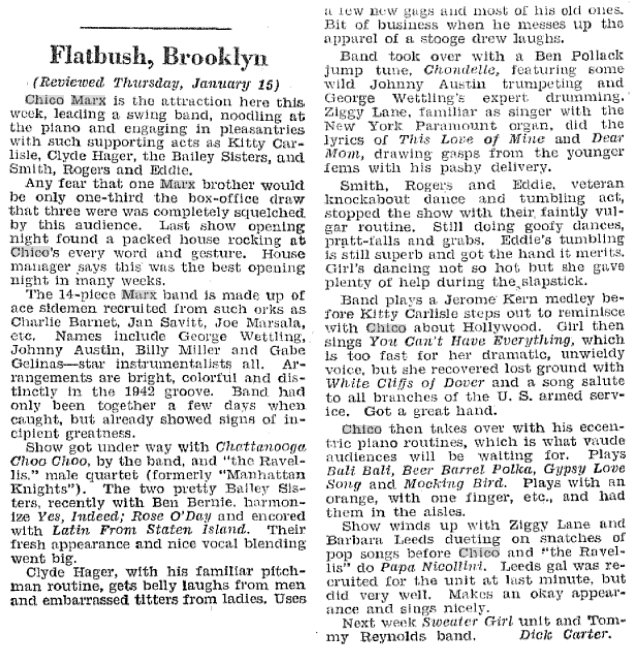 Billboard, 24 January 1942 Judging from the above piece in Billboard, it was the vocal group who was called the Ravellis, but even though Variety once referred to the band as Chico Marx and the Chicolets, the usual billing was Chico Marx and his Orchestra or Chico Marx, his piano, and orchestra or - simply - Chico Marx Orchestra. The idea of each member being attired in outfits identical with Chico's screen costume was probably never realized, but the music-stands and the drumskin at least sported a cartoon of Chico's head. After Brooklyn, the band moved on to the Windsor, Bronx and the Central, Passaic, New Jersey. On 2 March they played in Cumberland, Maryland, and later that month they appeared in Cleveland, accompanying harmonica-player Larry Adler. On 13 March 1942 the Chico Marx Orchestra performed at the Stanley Theater in Pittsburgh, a show which was broadcast locally over radio station WCAE as Stargazer Programme, hosted by Ray Spencer. A nine-minute segment of this show has survived but Chico is not heard on it. Vocalists at the time included Bobby Clark and Cpl. Ziggy Lane. Three days later, 16 March 1942, the band again performed at the Stanley Theater in Pittsburgh, this time in Keep 'Em Smiling, a public service broadcast for Defense Stamps. Vocalists were Ginny Perkins and - again - Ziggy Lane. Chico was interviewed and got evasive about questions regarding his personal life, then spent some time introducing members of the newly-formed ensemble. Lane was also interviewed. The program was originally scheduled to run 15 minutes, but it was allowed to run over by another 7 minutes. It was broadcast locally over radio station WWSW. Beginning on 4 April 1942, Chico's band played three nights at the RKO Temple Theater in Rochester, New York, and on the 11th, they played the RKO Boston Theatre in Boston (dates provided by Nancy Mess). 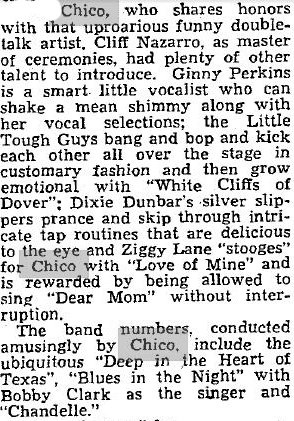 Daily Boston Globe, 11 April 1942 (provided by Nancy Mess)  Washington Post, 23 May 1942 (provided by Nancy Mess) On 24 May 1942 The Waterloo Daily Courier in Waterloo, Iowa, reported they were going to appear on the Paramount theatre in Waterloo "next Friday, Saturday and Sunday" (dates provided by Nancy Mess). While in Iowa they also played in Cedar Rapids and Sioux City. Around the year 2000, a set of autographs from the Chico Marx Orchestra from spring of 1942 were on sale on eBay. Chico's signature was dated "April 30th 1942, 10:45" and below this were some of the band's autographs, including Ziggy Lane, Marty Massala, Marty Napoleon, Bob Clark, Wally Brown and Nick Collins. These autographs are dated as May 30th 1942. Wally Brown (October 9, 1904 - November 13, 1961) was a vaudevillian (from Malden, Massachusetts) and the same may have been true for Collins. In June, two records were issued, with vocals by Ziggy Lane and Skip Nelson. That month they also played in Wisconsin, appearing in Sheboygan on the 8th, at the Capitol in Madison on the 13th and in Manitowoc on the 17th (dates provided by Nancy Mess). They also played in Oshkosh and Kenosha. In July, Chico Marx Orchestra played at the Palace on Main Street in Peoria, Illinois, and then played at the Orpheum in Los Angeles on 18 August 1942. 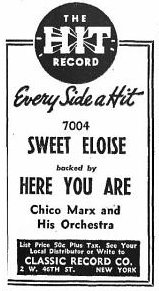 Billboard, 20 June 1942 In October, the band opened a two-month engagement at the Blackhawk Café in Chicago, broadcasting hightlights on a local radio show and drawing a crowd of 4000 to a venue supposed to hold 500 persons. It was around this time that Chicago-born Mel Tormé joined the band as singer and vocal arranger. He was very young - turning 17 on 13 September 1942 - but eventually replaced George Wettling as the band's drummer. Fuel rationing forced the band to remain in Chicago for two more months. Several of the band members were born in Chicago and of course Chico was no stranger to the town either, having lived there with the rest of the Marxes from 1909 to 1920 (see The Marx Brothers in Chicago). One evening Harpo surprised Chico with a visit to the Blackhawk and apart from playing the harp, Harpo is also reported to have held his trademark nonsensical speech from the dance floor, a speech which originated from Fun In Hi Skule and re-appeared over the years, for example in the stage version of Go West. More broadcasts followed after Tormé had joined the band, like a show for KLZ, Lake Side Park, in Denver (also featuring Elisse Cooper, Johnny Frigo and Bobby Clark as vocalists) and the Fitch Bandwagon on 20 December 1942, hosted by Toby Reed and eventually available on record. Chico Marx Orchestra spent New Years Eve at the Blackhawk in Chicago, and then played mostly in the east in the spring of 1943. Chico took time off for a short illness during which Harpo stood in for him for one week at the Cleveland Palace, and in April the band played at the Roxy in New York City. They were back at the RKO Boston Theatre in Boston around 23 April (date provided by Nancy Mess). The band broke up in July 1943 at the Golden Gate Theatre in San Francisco. The Chico Marx Orchestra was probably never caught on film. However, they left some traces in A Night In Casablanca and Love Happy, the Marx films that followed. In A Night In Casablanca, Chico is performing with a small jazz orchestra and it's likely that the routines that followed was based on performances by the Chico Marx Orchestra. The first number is even The second movement from the Beer Barrel Polka, followed by Moonlight Cocktail, a #1 hit for Glenn Miller and also featured on Mel Tormé's 1960 theme record Swinging on the Moon (consisting solely of songs about the moon as a romantic symbol). Beer Barrel Polka starts with Chico tapping a conductor's baton to get the attention of the band, then swinging the baton a couple of times in the air before throwing it at one of the trumpeters. Moonlight Cocktail is played with Chico and another pianist and has them and the whole band bouncing up and down in rhythm with the music. Soon, the bounces of Chico and the other pianist become unsynchronized and more and more violent. Finally, Chico has to stand up, caressing his behind with one hand while continuing to play with the other. Love Happy features Chico and violinist Leon Bellasco performing Gypsy Love Song, a recreation of Chico's routine with band member Johnny Frigo (and perhaps an even older number dating back from the days of Nightingales and Mascots when Chico performed in a similar way with either with cousin Lou Shean, Arthur Gordon or George Lee). Chico also performed a similar piano/violin-duel in a 1948 TV show, i.e. before Love Happy. The OrchestraThe line-up changed during the months but here are most of the people that were involved with Chico's bandBen Pollack Orchestra
leader, drums Mel Tormé vocals,
drums Johnny Frigo bass,
violin, vocals Barney Kessel guitar Paul
Villepigue
saxophone, clarinet Marty Napoleon piano George Wettling
drums Marty Marsala trumpet Bobby Miller piano [An earlier identification with piano-player,
composer, arranger and music publisher
Bob Miller (born in 1895 in Memphis, Tennessee, dead in 1955 in
New York City)
can't be satisfactorily verified, so I'm looking for any info on the
Bobby Miller
who played piano with the Chico Marx Orchestra in the early 1940s Vern Yocum saxophone,
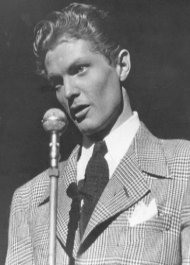
clarinet Kim Kimberly vocals Bobby Clark trumpet,
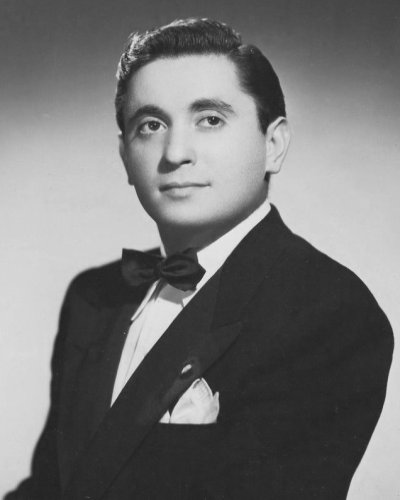
vocals Elisse "Sugar" Cooper vocals Ginny Perkins vocals Ziggy Lane vocals Skip Nelson vocals Hank Kmen clarinet |
radio broadcast for KLZ, Lake Side Park, Denver
and Bobby Clark, in Chicago circa 1941 (photo provided by Kim Clark Munroe)
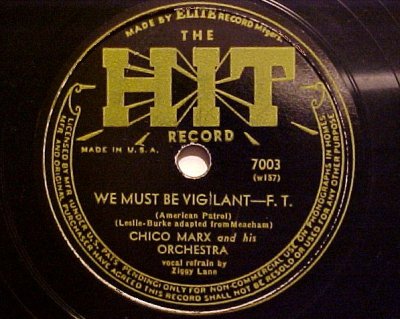
RecordsWe
Must Be Vigilant / Johnny
Doughboy Found a Rose in Ireland Sweet Eloise / Here
You Are Desi
Arnaz
& Chico Marx: The Great
Hollywood Orchestras (Laserlight 15767), CD 1992 Abraham vocals Mel Tormé Velvet Moon vocals Skip
Nelson Pagliacci instrumental Swing Stuff instrumental
swing version Beer Barrel Polka Chico Mister Five by Five vocals
Kim
Kimberly Chicago Strut instrumental Some of the other songs performedThis Love Is Mine vocals
Ziggy Lane (13
March 1942, Stargazer Programme WCAE) Dear Mom vocals Ziggy Lane Chattanooga Choo-Choo
instrumental Deep in the Heart of Texas
instrumental (13 March 1942, Stargazer Programme WCAE) Don't Sit Under the Apple Tree
vocals
Elisse Cooper (16 March 1942, Keep 'Em Smiling WWSW) I Dood It vocals Elisse
Cooper (16
March 1942, Keep 'Em Smiling WWSW) It Ain't Necessarily So
vocals Bobby
Clark My Momma Done Told Me vocals
Bobby
Clark (13 March 1942, Stargazer Programme WCAE) Gypsy Love Song Chico
&
Johnny Frigo Blues In the Night Larry
Adler
(harmonica) Begin the Beguine Larry
Adler
(harmonica) Hawaiian War Chant vocals
Ginny
Perkins Now They Call It Swing
vocals Ginny
Perkins Please Think Of Me sheet music from 1942 attributed to Chico Marx and his Orchestra 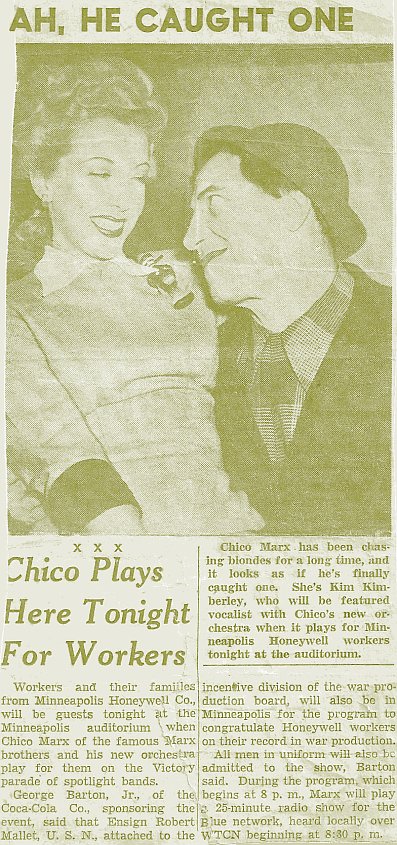 Newspaper clipping provided by Kim Clark Munroe |
 ~~
~~