[Main Page] | [History] | [Vaudeville] | [Misc.] | [Films & Film Projects]
| Mikael Uhlin's Marxology @ marx-brothers.org
[Main Page] | [History] | [Vaudeville] | [Misc.] | [Films & Film Projects] |
|
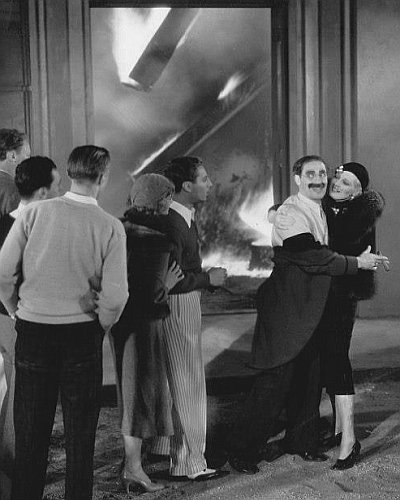
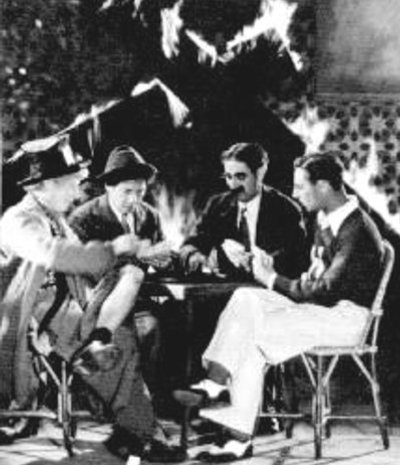
Horse Feathers was released on 10 August 1932. From start to finish - via the working titles The Marx Brothers at Yale and The Marx Brothers at Vassar to the College Widow (described by William Craigie and James Hulbert in A Dictionary of American English on Historical Principles as "a young woman who stays about a college year after year in order to associate with men students") and the concluding football game - it's a parody of the college movies that were popular at the time. The film also deals a bit with prohibition and bootleggers, and according to Groucho's grandson Andy Marx it was originally intended as a direct sequel to Monkey Business, but the idea of trivializing gangsters was dropped after the Lindbergh baby kidnapping in early 1932. Sadly, no complete version of the film exists today. Several scenes were cut at some time after the premiere. Since most of these scenes involved Harpo, it has been suggested that they at some time were used in a compilation or documentary. One of the scenes which have been tampered with is the one where the Marx Brothers and Jennings are trooping in and out of the apartment of Connie Bailey, the College Widow. This scene were based on Napoleon's First Waterloo from I'll Say She Is. After several incidents, Jennings orders Groucho and Chico to leave and then leave himself. The present version of Horse Feathers ends here but originally the sequence continued. Harpo has been hiding in the apartment and now leaps onto the couch beside Connie. "What do you want?" she asks sharply. Harpo points at her. "Are you a good boy?" Connie asks, and Harpo shakes his head. "You're bashful," she observes, presumably because he hasn't spoken. In answer, Harpo nods, looks bashful, and stands on his head in Connie's lap. She cries for him to get off her and he does, sitting alongside her on the sofa with one foot tucked under him. She tells him to take his foot off the sofa. Harpo shakes his head defiantly and makes his 'gookie' expression, so she tries to pull it off. She slaps him, a knock is heard, and he pulls her on to his lap. It is Groucho looking for his hat and rubbers. Connie points in one direction while the hidden Harpo points in another. Connie seems to be slapping herself as Harpo's hands become playful. "Come now, where's my hat?" asks Groucho and Connie seems to point in three directions at once. Groucho finds the rubbers on Harpo's feet, sticking out from underneath Connie, and mistakes them for hers. Eyeing the expanse of the muscular leg with the trousers rolled up, Groucho comments, "We could use you in the football team." Groucho takes off the rubbers and tries to put them on his own feet, but Harpo's feet are so positioned that he puts them back where they came from, on Harpo. Groucho tells Connie he can't live without her, but Chico enters and interrupts. Finally Jennings comes in, telling Groucho he'll teach him to fool around with his girl. Connie jumps up, revealing Harpo, clutching a block of ice beneath her. Groucho crawls through a window with an open umbrella while Chico and Harpo dart out of the door. Arriving below the window, Chico encourages Groucho to jump. Harpo brings out his dog catcher's net to arrest his fall. At just this moment a dog runs by and Harpo starts after it with the net. Groucho leaps and falls to the ground with a sickening thud. Another scene in the film depicts Harpo producing a hot cup of coffee out of his trouser pocket to give to a down-and-outer who had asked for money to buy a cup of coffee. In the longer version of the film this scene was preceeded by Harpo catching three dogs. First he lures one wire-terrier into his cart by simply letting it chase him there. Then he entices a police dog with a large portable lamppost which he sets up on the street. When the dog comes over to sniff at it, Harpo catches him in the net and places him in his wagon. Harpo repeats the process using a smaller lamppost and net in order to catch a puppy. The sign on Harpo's hat changes from Dog Catcher to Kidnapper in another now-missing scene where Harpo tries to net a girl. The finale of the film is also changed, but this was done before the release. According to the pressbook for Horse Feathers, the Huxley students tear the town apart for fuel and celebrate with a huge bonfire the night after the football game. However, Harpo decides the bonfire isn't big enough for such a sensational victory and his pyromaniacal book-burning bent in the film is carried to new heights as he sets fire to the college! Suddenly word comes that Jennings is trapped on the third floor. Groucho, cigar and all, runs into the blazing building amid cheers. He returns unexpectedly and hands a bystander his cigar. "There's no smoking in the corridors", he explains, and rushes back into the building. He reappears - not with Jennings, but with a diploma for Zeppo (and thus finally gets his son out of college). "I'll bet that'll burn Jennings up", he remarks as he retrieves his cigar butt. |

|