[Main Page] | [History] | [Vaudeville] | [Misc.] | [Films & Film Projects]
| Mikael Uhlin's Marxology @ marx-brothers.org
[Main Page] | [History] | [Vaudeville] | [Misc.] | [Films & Film Projects] |
|
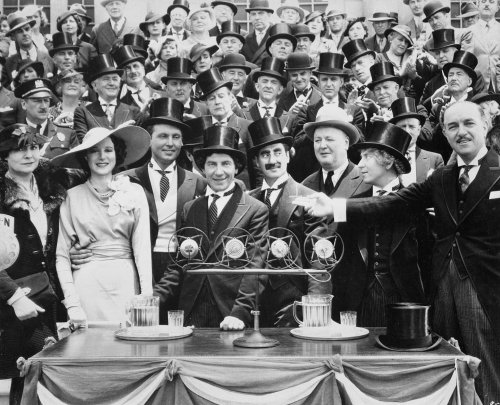
A Night at the Opera was the first Marx Brothers film for MGM, and the first made without Zeppo. Matthew Coniam notes in his book The Annotated Marx Brothers that The Motion Picture Herald 1 June 1935 annonunced the upcoming film as Raspberries. A Night at the Opera was released 15 November 1935. The original shooting script was issued in paperback in 1972. It indicates that the opening sequence was to have depicted the merry residents of Milan singing a song (both Cosi-Cosa and the chorus of Pagliacci have been suggested), with each singer passing the song along to someone else who continues to sing it. The song eventually winds up with the waiter in the restaurant, who apparently stopped singing just before he approched Mrs. Claypool. Pagliacci re-appears later in the film when Groucho sings a couple of lines of the song Vesti la giubba, albeit with his own lyrics: "Ridi Pagliacci...I love you very muchee...!" The scene where Groucho pulls up at the Opera House is
badly
cut with the picture and sound
jumping and being
out of sync. There is a terrible sound jump and the exterior shot of
the Opera House is only on screen for a split second. It may just have
been filler "atmosphere" shots of the opera house at night with people
arriving and taking their seats. Glenn Mitchell suggests the footage to
have been cut just before the initial release with even more footage
snipped from the 1949 reissue. Another theory is that all German and
Italian references were removed from the film during WWII and never
replaced. The trailer for the film features footage of Groucho, Harpo
and Chico walking away from the unconsious Lasparri and also footage of
the Marx Brothers and Allan Jones in the ticker tape parade. None of
these appears in the finished film.
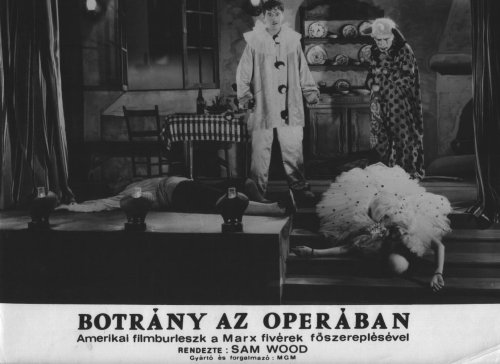
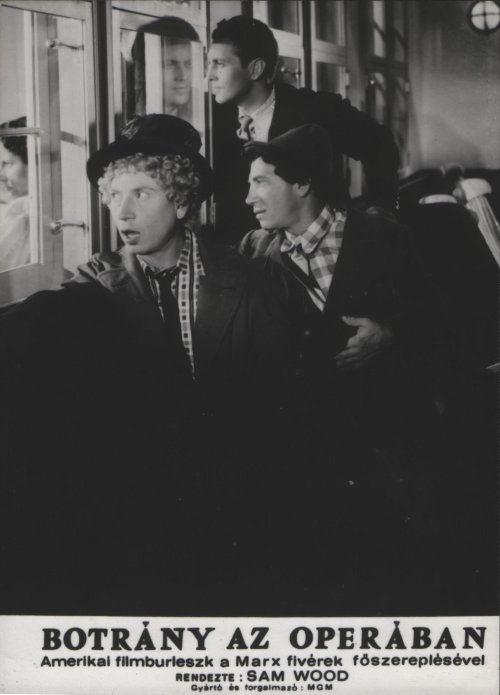
The complete cast list from the film as presented in MGM: The Golden Years, names several characters who actually don't appear in the film, such as Count DiLuna and Ferrando. In an email sent to me on 5 November 2001, Dale Blasingame points out that these are actually from Verdi's Il Trovetore, the opera around which the film is written. "It is possible that these parts were to have been featured and were simply edited for time or some other reason" Dale writes. In an email I received on 2 February 2002, Kay Lhota cites the 1972-book with the script of A Night at the Opera. According to the script, a fire breaks out while all of the crazy goings on at the theater goes on and the Marxes manage to keep the audience from panicking while Ricardo and Rosa hold the audience with their beautiful voices. The last scene of the film (shot at a set that looks like the one used in the Russian Aviators speech scene) was to be the Mayor congratulating the heroes for saving the theater audience (photo provided by Kay Lhota). The Hungarian discoveriesIn 2007 and 2008, Hungarian marxologist Racz Tamas made several important discoveries concerning A Night at the Opera. The first was a Hungarian movie poster depicting an otherwise unknown scene which probably appeared early in the film as it shows Lasparri in clown costume alongside Harpo and Rosa. As can be seen in the present version of the film, Lasparri is appearing with Rosa in a performance of Pagliacci ("Clowns"). That story ends with the jealous Canio (alias Pagliaccio) killing his wife Nedda (alias Colombina) and the villager Silvio. In the play, there's also a fool named Tonio (alias Taddeo). To judge from this, the photo shows Lasparri as Canio/Pagliacci right after he has killed Nedda/Colombina (played by Rosa) and Silvio. To the right stands the horrified witness Tonio/Taddeo, played by Harpo. Next came another movie poster showing yet another scene which isn't in the movie. It's a photo of Harpo, Chico and Allan Jones sitting in front of a window looking in a room on the boat's deck, and in that room sits Maggie Dumont. There is a known alternative shot of this showing them from the room looking in, with Harpo making a cockeyed grimace. After this, Racz Tamas visited the Hungarian National Film Archive to see if they actually had an uncut print of A Night At the Opera, and he found something very interesting indeed! This is his own story: "I watched the first reel of the print of the
Hungarian National Film Archive, to find two additional shots, two
additional sentences, and different angles of already known shots. The
first thing that absolutely shocked me was that when Harpo and Chico
are backstage, the music of the opera was loud, and instead of the shot
of Lasparri singing in his white clothes, they showed a man singing who
wasn't him, and he wore different clothes. Then Chico said to Allan
Jones "Someday you're gonna be where Lasparri is", but
the man who was
singing wasn't Lasparri at all. The other shock was when Kitty Carlisle
was singing. It was her, but
she sang a different part of the opera, and she was only shown above
the waist, rather than what is in the DVD version, where she is
standing, and we can see a man behind her. In the scene, when Groucho
and Chico first meet, when they are standing on Lasparri, I found two
additional sentences. Chico: "I'm a stranger here myself"
(This
line is in the DVD
edition, but
right after it you can see a jump cut) As you can see references to Italy were indeed cut, but it still does not contain the 4 minute street singing intro that people were talking about. Unfortunately I could only watch the first reel, which ends in the middle of the contract scene. It was extremely expensive to do. It cost me two times more than to buy the DVD. I asked them about transferring this version to DVD just to preserve the film, and they told me that it would cost a lot of money, and that I have to speak to the owner of the rights of this film." So far Racz Tamas. The existence of a more complete version of A Night at the Opera is of course big news in the Marxonian world and I would like to see an international effort to preserve this version. Also, I think the copyright-holder should be very interested in the possibility to restore this Marx Brothers classic. |
|