
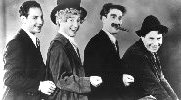
Chico Marx
Born: March 22, 1887 in New York City, NY
Died: October 11, 1961 in Hollywood, CA
Chico was the second child in the Marx family, but his older brother Manfred died in infancy, so Chico had the role of the oldest. His given name was Leonard. The legend for his nickname "Chico" says that he got it from chasing "chicks". He was the favorite son of his mother Minnie and it showed in what she let him get away with. He was always willing to take any bet, and would be a life long gambling addict. He was also famous for his way with the opposite sex.
Chico always had a smile, a game of pinochle, and a lady. He was probably the most reckless of the group but it often paid off for them all. It was his ideas and drive that made the other boys hang in there during the tough times. It was Chico who lead them to greater success when he saw the first musical tabloid shows and decided that it was a perfect format for the group. This came at a time when spirits were down over low bookings for the much toured "Mr. Green's Reception". He acted as the Manager of the group right after Minnie was retired. Chico was able to act as the focus of the groups energies and it was this focus which lead the group to Broadway and the silver screen. It was also due to Chico's ability to charm people that the Brothers ended up working with Irving Thalberg.
Chico played in all Marx Brothers vaudeville shows and films. He also did a radio show with Groucho and later worked as a musician. He remained a performer for all his life, often working the same small circuits as an old man that he had worked as a boy. He had to do this because of the amount of money he lost over the years gambling. He was once asked how much money he had lost and his reply was "Ask Harpo how much he's made and that' how much I've lost." Chico died in 1961, after a long battle with heart disease. At his funeral a man stood up and began eulogizing him. He painted a totally inaccurate picture of who Chico Marx had been. It got so bad at one point during the service Harpo leaned over to Maxine and whispered "When I go, do me a favour and hire a mime."
Chico Marx appeared in the following movies:
| Film Title | Character name |
|---|---|
| Humor Risk - 1921 | (Italian)? |
| The Cocoanuts - 1929 | Chico |
| Animal Crackers - 1930 | Signor Emanuel Ravelli |
| Monkey Business - 1931 | A Stowaway |
| The House That Shadows Built - 1931 | |
| Horse Feathers - 1932 | Barovelli |
| Hollywood on Parade No.5 - 1932 | |
| Duck Soup - 1933 | Chicolini |
| Hollywood on Parade No.9 - 1933 | |
| A Night at the Opera - 1935 | Fiorello |
| Hollywood: The Second Step - 1936 | Himself |
| A Day at the Races - 1937 | Tony |
| Room Service - 1938 | Harry Binelli |
| At the Circus - 1939 | Antonio Pirelli |
| Go West - 1940 | Joseph Panello |
| The Big Store - 1941 | Ravelli |
| Screen snapshots No. 8 - 1943 | |
| A Night in Casablanca - 1946 | Corbaccio |
| Love Happy - 1949 | Faustino |
| The Story of Mankind - 1957 | Monk, adviser to Christopher Columbus |
| Showdown at Ulcer Gulch - 1958 |
Important dates in the life of Chico Marx:
| 22 Mar 1887 | Leonard "Chico" Marx is born |
| Feb 1910 | When joined by Minnie Marx and aunt Hannah Schickler The Four Nightingales become The Six Mascots |
| 1912 | Fun in Hi Skule is the first musical sketch of the Brothers. This half-hour 'school act' features the four brothers, Paul Yates and others |
| 1913 | Mr. Green's Reception is a followup to Fun in Hi Skule |
| 1914 | Home Again is developed from the second half of Mr. Green's Reception |
| 22 Mar 1917 | Chico marries Betty Carp |
| 1918 | In The Cinderella Girl Zeppo replaces Gummo. This musical comedy is written by Jo Swerling with music by Gus Kahn |
| Jan 1918 | Maxine, daughter of Chico and Betty, born |
| 1921 | On the Mezzanine Floor (in England: On the Balcony) a musical revue written by Herman Timberg, produced by Benny Leonard |
| 1921 | The silent movie Humorisk is made with money raised by a friend. Director is Jo Swerling. It was made in two weeks at Fort Lee, NJ. studios and in a studio at 49th St. and 10th Ave. in New York. No copy exists of this (unfinished?) film. |
| 19 May 1924 | Stage show I'll say she is, scripted by Will B. Johnstone, opens at the Casino Theater in New York |
| 8 Dec 1925 | Stage show The Cocoanuts opens at the Lyric and runs for 275 performances, a full season on Broadway, as well as two years on the road. |
| 23 Oct 1928 | Stage show Animal Crackers opens at the 44th Street Theater and runs for 191 performances. It was laid off the following summer, went on tour in mid-October. |
| 3 Aug 1929 | Film The Cocoanuts released |
| 6 Sep 1930 | Film Animal Crackers released |
| 5 Jan 1931 | The Marxes appear at the London Palace Theatre |
| 19 Sep 1931 | Film Monkey Business released |
| 31 Aug 1932 | Film Horse Feathers released |
| 28 Nov 1932 | Groucho's & Chico's radio series "Beagle, Shyster & Beagle" (later: "Flywheel, Shyster & Flywheel") debuts on NBC |
| 24 Nov 1933 | Film Duck Soup released |
| 22 Nov 1933 | New York Premiere of "Duck Soup" |
| 15 Nov 1935 | Film A Night at the Opera released |
| 11 Jun 1937 | Film A Day at the Races released |
| 30 Sep 1938 | Film Room Service released |
| 8 Nov 1938 | Chico appeared on NBC radio's "The Bob Hope Show." |
| 1939 | The Kellog's Show on radio with Groucho and Chico |
| 20 Oct 1939 | Film At the Circus released |
| 1940 | In the 1940s Chico and Betty get divorced |
| 6 Dec 1940 | Film Go West released |
| 20 Jun 1941 | Film The Big Store released |
| 20 Dec 1942 | Chico Marx and his orchestra (with vocalists Mel Torme and Ben Pollack) appeared on "Fitch Bandwagon." |
| 1943 | Chico has his own band |
| 1944 | Chico appears in the revue Take a Bow |
| 10 May 1946 | Film A Night in Casablanca released |
| 5 Oct 1948 | Chico's TV debut on NBC's Texaco Star Theater |
| 9 Jan 1949 | The TV programme "Papa Romani" featuring Chico is broadcast on CBS |
| 17 May 1949 | Chico Marx arrives at Frankfurt/Main, Germany, to begin a five-day tour in which he and a group of English entertainers were to perform at military bases. |
| 3 Mar 1950 | Film Love Happy released |
| 9 Dec 1950 | Chico's piece, "Here's my All-American Football Selections for 1950," appeared in TV Forecast; the magazine also had an ad for Chico's show "College Bowl" |
| 20 Jan 1952 | Chico is a guest on "Celebrity Time" on CBS TV |
| 1953 | The TV series College Bowl features Chico |
| 8 Nov 1957 | Film The Story of Mankind released. Chico, Harpo and Groucho appear in this film, but not together in one scene |
| 1958 | TV production Next to No Time with Chico |
| Aug 1958 | Chico marries Mary De Vithas |
| 8 Mar 1959 | The TV film The Incredible Jewel Robbery is the last film to have three Marx Brothers |
| 16 Oct 1960 | Chico Marx and Ivan Erdos were pitted against John Gerber and Edith Kemp on ABC television's "Championship Bridge," hosted by Charles Goren (Chico lost horribly). |
| 11 Oct 1961 | Chico dies of arteriosclerosis |
| 16 Jan 1977 | The Marxes are inducted to the Motion Picture Hall of Fame |

