[Main Page] | [History] | [Vaudeville] | [Misc.] | [Films & Film Projects]
| Mikael Uhlin's Marxology @ marx-brothers.org
[Main Page] | [History] | [Vaudeville] | [Misc.] | [Films & Film Projects] |
|
Horse Feathers
was Paramount's biggest hit of 1932 and after a wildly successful
preview, the studio announced on 2 August that they should rush out
another film with the Marx Brothers while they were hot. Already at
this early stage, the story (provisionally entitled Oo La La)
was set in a mythical kingdom. On 11 August 11, The Los
Angeles Times
reported that production should commence in five weeks with Ernst
Lubitsch directing. But this was a turbulent period in the Marx
Brothers career. A reorganization of Paramount Pictures brought fears
that money due the Marxes would never be paid and the contractual
dispute culminated in the team threatening to go it alone as Marx
Bros., Inc. Their first independant film was to be Of Thee I Sing,
the first musical to win a Pulitzer Prize, with Norman McLeod leaving
Paramount to direct. During the winter of 1932-33, Groucho and Chico
was also working with Flywheel, Shyster and Flywheel,
a radio
series written by Nat Perrin and Arthur Sheekman and there was at one
time talk of casting them in their radio characters for the new film.
It was 4 October before Arthur Sheekman, Bert Kalmar and Harry Ruby
began writing the screenplay for the next Paramount film, which was now
called Firecrackers. Herman Mankiewicz was to
supervise production, beginning in January. By December 1932 Firecrackers
had become Cracked Ice. It has been claimed that
Grover Jones also contributed to the first draft by Kalmar and Ruby.
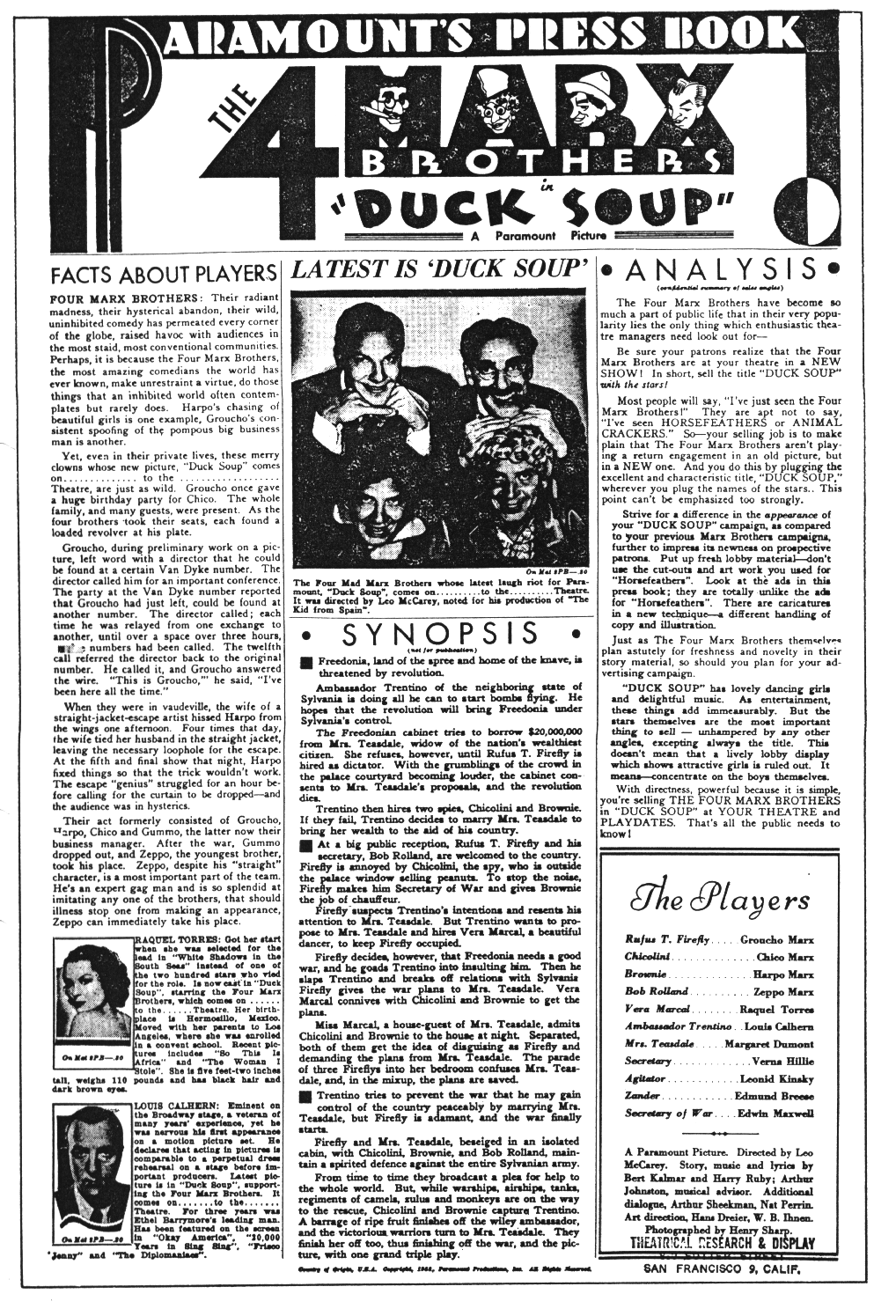
In February 2000, I was contacted by fellow Marxonian Kevin Kusinitz. He wrote about an orginal typewritten copy of the first treatment for Duck Soup, which he had bought at auction several years ago for $ 25. The scanned pages of this treatment is presented on this site (see below). This interesting item features the original title, Firecrackers, crossed out and replaced by Cracked Ice, which, in turn, is crossed out and replaced by Duck Soup. It seems to me that this is the obscure first draft of Cracked Ice or - as it says - Firecrackers. This is suggested not only by the changes of the title but also by the dates in the treatment, the number of pages (27 as opposed to 98 in the second draft) and also a comparision with excerpts from this draft, as presented in Simon Louvish's book Monkey Business. In both versions, Groucho is named Rufus T. Firestone, but in the second draft the names Trentino and Sylvania are established, as opposed to Frankenstein and Amnesia in this supposed first version. Zeppo is Groucho's son, but that was changed very late in production, as is evident from the first radio trailer. On 18 January 1933 Harry Ruby, Bert Kalmar and Grover Jones submitted to Paramount their Second Temporary Script for Cracked Ice (98 pages, provided by Marie Sunny), and Paramount announced that filming would begin on 15 February. According to Wesolowski, the script reveals that the basic story line of what would become Duck Soup had been set. In February Paramount announced that the title had been changed to Grasshoppers ("because animal stories are so popular"), and that filming was set back to 20 February. On 11 May 1933, the Marx Brothers' beloved father Sam "Frenchie" Marx died in Los Angeles of a heart attack, and shortly afterwards, the dispute with Paramount was settled. The New York Post reported on 17 May that the Marxes would make a new comedy for Paramount, called Duck Soup. Leo McCarey would direct the film. Three days later The New York Sun reported that Duck Soup would start filming in June. Duck Soup's script was completed on 11 July. It was clearly a continuation of Kalmar-Ruby's Firecrackers/Cracked Ice-drafts but contained more elements. Michael Barson shows that fifteen routines from the Flywheel-radio show were transplanted into the script, with Perrin and Sheekman receiving an "additional dialogue"-credit. Lost along the way was a scripted romance between Zeppo and Raquel Torres and with it a Kalmar-Ruby love song called Keep On Doing What You're Doing, used instead for the following year's Wheeler & Woolsey comedy Hips, Hips Hooray (where Wheeler & Woolsey performs it with Dorothy Lee and Thelma Todd). It's a lovely tune and I can just imagine Zeppo and Groucho singing it with Raquel and - why not? - Thelma. Director Leo McCarey had worked with Laurel
& Hardy at Hal Roach's studio, and he contributed more
ingredients of Duck Soup,
including the title (which had been used for a Laurel & Hardy
two-reeler released in 1927) and the very Laurel & Hardy-like
sequence in which Harpo and Chico stage a break-in at Mrs Teadale's
house. Another McCarey contribution, the mirror routine, (according to Variety
invented by the old stage act the Schwartz Brothers) had been used by
Charlie Chaplin in 1916's The Floorwalker and by
Max Linder in Seven Year's Bad Luck (1921).
Like most other film studios, Paramount launched a series of
radio trailers in the early 1930s. They were called The
Paramount Movie Parade and the first two promos in this
series from 1933 featured highlights from Duck Soup.
As the film was still in production at the time, both promos offers a
lot of out-takes and an insight into the making of Duck Soup.
The radio trailers are mostly made up of alternate takes with
additional lines of dialog that did not appear in the movie. The movie
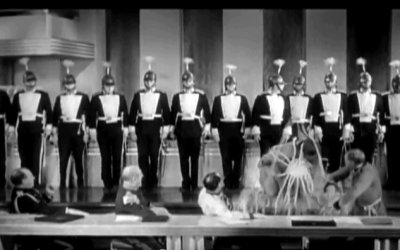
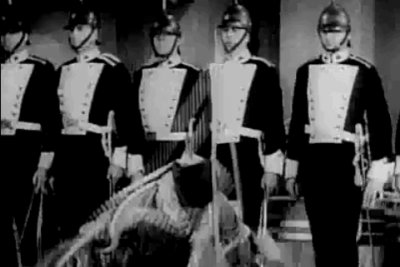
trailer also contains some alternate takes or angles, for example when
Harpo marches in with the guards and throws his stick in the air which
causes the chandelier to fall down on him.
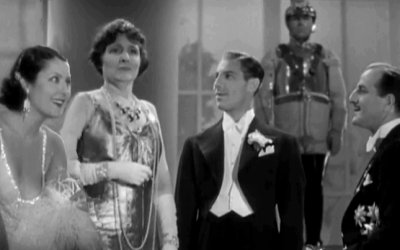
...lasts 12 minutes and 33 seconds. It opens with music previously used for the Monkey Business-promo a couple of years earlier, probably because Duck Soup's title music hadn't been recorded yet. The Marx Brothers are presented as Rufus T. Firefly (Groucho), Chicolini (Chico), Skippy (Harpo) and Bob Firefly (Zeppo), son of Rufus. When the film was released, the characters of Harpo and Zeppo are renamed Pinky and Bob Roland. The clip from Firefly's inauguration is an alternate take with background music, variations of inflections and some subsequently deleted lines. For example, Firefly comments on the reception; All this for me? That's how you throw away your money. I'd rather have a good box of cigars before dismissing the guards. When Mrs Teasdale asks Groucho to follow in the footsteps of her late husband, the promo adds a line later deleted; Without my husband, I have only you to fall back on. There's also an additional exchange with Ambassador Trentino: Trentino I bring you a
message of
goodwill. On behalf of my president - In the radio trailer, the song Just Wait 'Til
I Get
Through With It
has an added interlude with a bass singer, followed by a bluesy
trumpet. There's also an instrumental version of the song which isn't
in the film.
Firefly's meeting at the House of Representantives offers one extra
line, but there's also a deleted sequence before the conversation with
Chicolini; Zeppo It's that's infernal
peanut
vendor, Chicolini. The first promo ends with alternative versions of the Freedonian
National Anthem and the Heighdy-ho-section
of The Country's Going to War. ...lasts 13 minutes and 52 seconds. By this time, Paramount has recorded theme music for the program and this clip also features the actual overture from Duck Soup, although with slightly different duck effects. By now, Harpo's character has no name, he's just "a spy", while Zeppo's character is simply Bob, Firefly's secretary. Vera Marcal doesn't appear in this clip but is introduced as Trentino's niece. As Glenn Mitchell points out in The Marx Brothers Encyclopedia this is "a designation traditionally used when checking into a hotel". This clip takes up where the previous broadcast left off, as Firefly offers Chicolini a cabinet position as Secretary of War. Before asking Chicolini about the standing army, there's an additional "Say, wait a minute!" from Firefly. There are a few extra lines from Mrs Teasdale's garden party and also an alternate take of the song The Country's Going To War/All God's Chillun Got Guns. It's less tightly performed than in the final recording and Zeppo's "How we'd cry for Firefly"-solo disappears into the chorus. The battle scenes contains an extra line from Groucho: "Chicolini, I used to think you were two-faced, but you can't be, or you wouldn't be wearing that one!" Both Duck Soup-promos from The Paramount Movie Parade are available (among several other items) in Real Audio on Frank Bland's Why A Duck-site, in the Streaming Audio Files section. Duck Soup was released 17 November 1933.Fire Crackers / Cracked Ice / Duck Soup (first
treatment) |
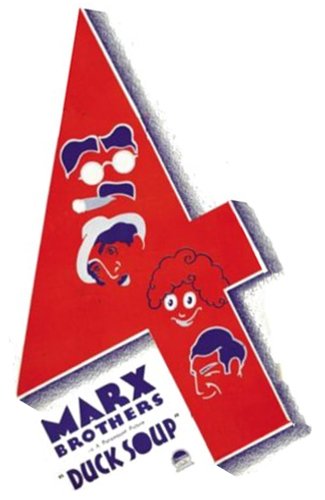
sources:
The Making of Duck Soup & Flywheel, Shyster and
Flywheel, article by Paul G. Wesolowski in The Freedonia
Gazette no 21, 1988
|